

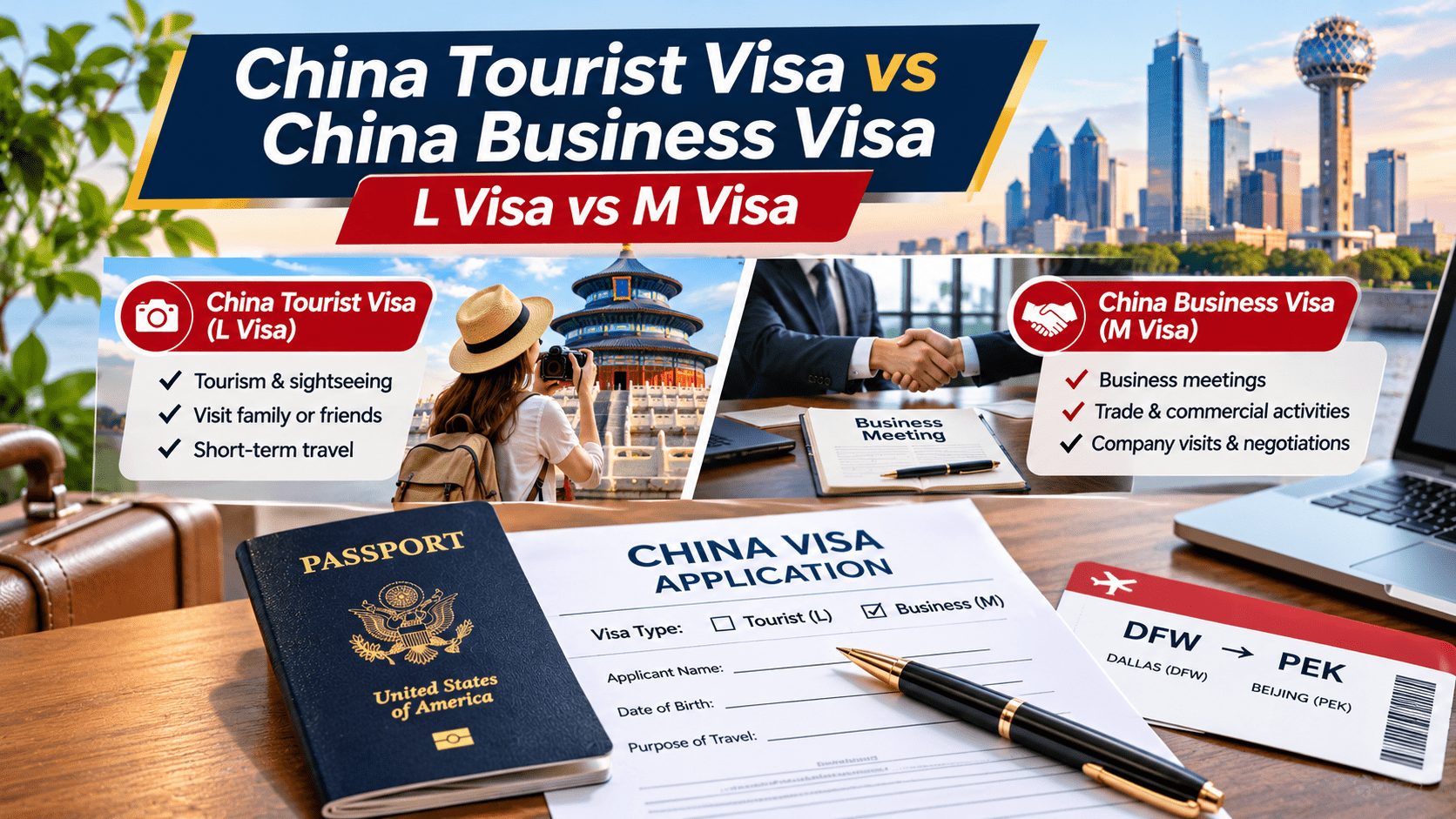
China Tourist Visa vs China Business Visa: What’s the Difference?
If you are planning a trip to China from Dallas or elsewhere in the United States, one of the first things you need to determine is why you are traveling. That purpose usually determines which China visa category you should apply for.
For many U.S. travelers, the choice comes down to two common visa types:
China Tourist Visa, or L visa
China Business Visa, or M visa
Both are short-term visa categories, but they serve different purposes and normally require different supporting documents.
The tourist L visa is intended for people traveling to China mainly for tourism and leisure. The business M visa is intended for travelers entering China for commercial and trade activities.
Choosing the correct visa category matters because the information on your application, your supporting documents, and your stated travel purpose should all be consistent.
If you are based in Dallas, Richardson, Plano, Frisco, Garland, Irving, Arlington, Fort Worth, or elsewhere in the DFW Metroplex, AA Passport & Visa can help you prepare through its China visa service.
This guide explains the major differences between China tourist visas and China business visas, including eligibility, documentation, current fees, processing times, the online COVA system, and how to decide which visa fits your trip.
What Is a China Tourist Visa?
A China Tourist Visa, commonly called an L visa, is designed for travelers whose primary purpose is tourism.
Typical tourist activities may include:
Sightseeing
Vacation travel
Visiting major attractions
Leisure trips
Cultural tourism
Traveling through Chinese cities as a visitor
Popular destinations may include Beijing, Shanghai, Guangzhou, Chengdu, Xi’an, Shenzhen, Hangzhou, and many other cities.
If your primary reason for traveling is vacation or sightseeing, the L visa is generally the category that fits your trip.
The Chinese Embassy currently identifies the L visa as the visa category for tourism.
Travelers should still remember that the final decision on visa type, number of entries, validity, and permitted stay belongs to the Chinese consular authorities.
What Is a China Business Visa?
A China Business Visa, commonly called an M visa, is intended for travelers visiting China for commercial and trade activities.
Common examples include:
Meeting business partners
Visiting suppliers
Attending trade meetings
Negotiating contracts
Inspecting factories
Meeting manufacturers
Discussing commercial projects
Participating in trade-related activities
The M visa is different from a Chinese work visa.
If you are traveling to China to take employment, work for a Chinese employer, or perform activities that require employment authorization, you may need a different visa category.
The M visa is intended for short-term business and commercial activity rather than long-term employment.
China Tourist Visa vs China Business Visa: Quick Comparison
| Category | China Tourist Visa | China Business Visa |
|---|---|---|
| Visa Type | L Visa | M Visa |
| Main Purpose | Tourism and leisure | Commercial and trade activities |
| Typical Traveler | Tourists and vacationers | Business owners, executives, buyers, suppliers |
| Invitation Letter | Generally not required under current simplified tourist rules | Normally required or supported by business documentation |
| Hotel / Flight Booking | Generally not required under current simplified U.S. tourist rules | Commercial supporting documents are more important |
| Application System | COVA online system | COVA online system |
| Government Fee for U.S. Citizen | $140 regular service | $140 regular service |
| Express Service | Additional $25 when available | Additional $25 when available |
| Regular Processing Reference | About 4 business days after passport submission | About 4 business days after passport submission |
| Express Processing Reference | About 3 business days when accepted | About 3 business days when accepted |
The main difference is straightforward:
Tourism = L visa
Commercial or trade activity = M visa
Current China Tourist Visa Requirements
China simplified tourist visa documentation for applicants in the United States.
Under the current rules, tourist L visa applicants in the United States are generally not required to provide:
Round-trip airline reservations
Hotel reservations
A detailed travel itinerary
A tourist invitation letter
That makes the current tourist visa process simpler than some older China visa checklists you may still find online.
However, applicants must still provide the basic required documents and complete the current online application process.
The Chinese Embassy may also request additional documents depending on the individual case.
You can review the official Chinese visa application requirements and procedures before applying.
China Business Visa Requirements
The China M visa normally requires stronger business-related supporting documentation.
The Chinese Embassy currently requires documents connected to the commercial activity and the trade or business relationship in China.
This commonly includes an invitation letter or other commercial documentation from a Chinese business partner.
The invitation may include information such as:
Applicant’s full name
Passport information
Purpose of travel
Planned business activities
Dates of the visit
Information about the inviting company
Contact information
Relationship between the applicant and the company
Signature or company details
Because the M visa is based on commercial activity, the business invitation is one of the clearest differences between the M and L visa categories.
If your trip includes both business and tourism, the primary purpose of the trip should guide the visa category you choose.
The China Online Visa Application System
China now uses the China Online Visa Application system, commonly referred to as COVA, for visa applicants in the United States.
The process generally involves:
Completing the visa application online
Uploading the required documents
Waiting for preliminary review
Following instructions when the application is ready for passport submission
Submitting the passport and any required original documents
Waiting for final visa processing and collection instructions
This means travelers should not rely on older instructions that describe only a paper-based China visa process.
The current system is much more digital at the initial application stage.
For Texas residents, including Dallas-area applicants, jurisdiction is currently handled through the Chinese Embassy in Washington, D.C.
That jurisdiction point is important because China visa applications are generally routed according to where the applicant resides.
AA Passport & Visa can help Dallas and DFW travelers understand the current online application process and prepare the supporting documents before submission.
Passport Requirements for a China Visa
Your passport itself must also meet current China visa requirements.
The current Chinese Embassy guidance generally requires:
More than six months of remaining passport validity
At least two blank visa pages
You will also need to upload the biographical page of your passport during the online application process.
If your passport is close to expiring or does not have enough blank pages, it may be better to resolve the passport issue before starting your China visa application.
If your passport needs renewal, review the AA Passport & Visa passport renewal service.
If you need a brand-new U.S. passport, see the New Passport Dallas service.
You can also read our previous guide on first-time U.S. passport requirements in Dallas if you are applying for your first passport before starting the China visa process.
China Visa Fees for U.S. Citizens in 2026
China has extended its reduced visa fee policy through December 31, 2026.
For U.S. citizens, the current regular Chinese government visa fee is $140.
Express service, when accepted, currently adds $25.
Current China Visa Government Fee Table
| Service | Government Fee for U.S. Citizen |
|---|---|
| Regular China visa service | $140 |
| Express service surcharge | +$25 |
| Total with express service | $165 |
These are Chinese government or consular visa fees.
They are separate from any professional service fee charged by AA Passport & Visa.
You can review the official China visa fee notice for the current fee schedule.
AA Passport & Visa Service Fees
AA Passport & Visa is a private passport and visa expediting company.
Its professional service fees are separate from:
Chinese government visa fees
Consular charges
Shipping costs
Express service charges
That distinction is important.
If a traveler pays AA Passport & Visa for professional assistance, that private service charge should not be confused with the Chinese government’s visa fee.
How Long Does a China Visa Take?
Current Chinese Embassy guidance lists average processing times after passport submission of approximately:
Regular service: 4 business days
Express service: 3 business days in urgent cases when accepted
These are reference processing times, not guaranteed completion dates.
Some applications may take longer because of:
Additional document review
Jurisdiction questions
Application inconsistencies
Holidays
Individual case review
Requests for additional information
For that reason, it is better to begin the China visa process well before your planned departure.
Does a China Tourist Visa Require an Invitation Letter?
Under the current simplified U.S. rules, a tourist L visa applicant generally does not need to provide an invitation letter.
Tourist applicants also generally do not need to submit:
Round-trip flight reservations
Hotel bookings
A detailed itinerary
That is an important update because many older China visa guides still tell travelers to prepare those documents automatically.
However, the Chinese Embassy still has the authority to request additional information if needed.
The safest approach is always to follow the current official guidance rather than relying on an old checklist.
Does a China Business Visa Require an Invitation?
For a business M visa, supporting commercial documentation is normally required.
This typically includes a business invitation or related documentation from a trade partner in China.
The purpose is to show:
Who is inviting you
Why you are traveling
What commercial activity you will perform
How long the trip is expected to last
Which company or organization is involved
This requirement is one of the biggest practical differences between the tourist L visa and the business M visa.
Can You Use a Tourist Visa for Business Meetings?
You should apply for the visa category that matches the actual primary purpose of your trip.
A tourist L visa is intended for tourism.
A business M visa is intended for commercial and trade activities.
If you are traveling mainly to:
Meet suppliers
Negotiate contracts
Visit factories
Attend trade meetings
Meet business partners
then an M visa is generally the more appropriate category.
Applying for a tourist visa simply because the documentation looks easier is not a good strategy.
Your visa application, supporting documents, and stated travel purpose should be consistent.
Can You Use a Business Visa for Tourism?
Someone traveling on a valid business visa may naturally have some personal free time during the trip.
However, the visa application itself should accurately reflect the primary purpose of travel.
If the main purpose is tourism, the L visa is generally appropriate.
If the main purpose is commercial or trade activity, the M visa is generally appropriate.
The key is honesty and consistency.
What About the China F Visa?
The F visa is another category that sometimes causes confusion.
The current visa system distinguishes the F visa from the M visa.
The M visa is for commercial and trade activities.
The F visa is generally used for exchanges, visits, study tours, and certain other non-commercial activities.
Examples might include:
Academic exchanges
Cultural exchanges
Certain research visits
Study tours
Non-commercial institutional visits
If your trip is not clearly tourism or commercial trade, you may need to review whether another visa category is more appropriate.
Can U.S. Citizens Travel to China Without a Visa?
In most cases, U.S. citizens still need a valid Chinese visa before traveling to mainland China.
China has expanded visa-free entry for citizens of several countries, but U.S. passport holders are not currently covered by the general 30-day unilateral visa-free policy.
Limited exceptions may apply in certain transit situations or special travel programs.
Before traveling, U.S. citizens should review official entry rules and the current China travel information from the U.S. Department of State.
Which China Visa Should You Choose?
The easiest way to decide is to ask one question:
What is the main purpose of your trip?
Choose a China Tourist L Visa if your primary purpose is:
Vacation
Sightseeing
Leisure travel
Tourism
Choose a China Business M Visa if your primary purpose is:
Trade
Business meetings
Supplier visits
Commercial negotiations
Factory visits
Company-related commercial activity
If you are still unsure, review the details of your trip before submitting the application.
Choosing the correct category from the beginning can reduce the risk of delays or additional document requests.
Common China Visa Mistakes to Avoid
Applying for the Wrong Visa Category
Your visa type should match the real purpose of your trip.
Following Old Instructions
China’s application process has changed.
The current COVA process and simplified tourist document rules are different from many older visa instructions still published online.
Not Checking Passport Validity
Your passport should generally have more than six months of remaining validity and at least two blank visa pages.
Missing Business Documentation
Business M visa applicants should prepare the required commercial documentation from their Chinese business partner.
Assuming the Processing Time Is Guaranteed
Four business days is a reference processing time, not a guaranteed delivery date.
Mixing Government Fees With Private Service Fees
The $140 regular fee is the Chinese government visa fee for U.S. citizens under the current reduced-fee policy.
AA Passport & Visa professional fees are separate.
China Visa Help for Dallas and DFW Travelers
Applying for a China visa can become more complicated when you are dealing with:
Business invitations
Travel deadlines
Passport expiration
Previous Chinese visas
COVA requirements
Jurisdiction issues
Commercial travel
Multiple-country itineraries
Supporting documents
AA Passport & Visa provides private passport and visa assistance for travelers throughout Dallas and the DFW Metroplex.
The company serves customers in:
Dallas
Richardson
Plano
Frisco
Garland
Irving
Arlington
Fort Worth
Surrounding DFW communities
If you are preparing for travel to China, start with the AA Passport & Visa China visa page or call (972) 231-1600.
You can also review AA Passport & Visa locations if you need assistance from another service area.
AA Passport & Visa is a private passport and visa expediting company and is not affiliated with the Chinese government, the Chinese Embassy, or the U.S. government.
Frequently Asked Questions
What is the difference between a China tourist visa and a China business visa?
A China tourist visa, or L visa, is intended for tourism and leisure travel, while a China business visa, or M visa, is intended for commercial and trade activities. The correct visa depends on the primary reason for your trip. For help reviewing your situation, call AA Passport & Visa at (972) 231-1600.
Do U.S. citizens need an invitation letter for a China tourist visa?
Under the current simplified rules for U.S.-based tourist visa applicants, an invitation letter is generally not required. Round-trip airline bookings, hotel reservations, and a detailed itinerary are also generally not required, although additional documents may still be requested.
Does a China business visa require an invitation letter?
A China M visa normally requires supporting documentation related to the commercial activity from a trade or business partner in China. This commonly includes an invitation letter or similar business documentation explaining the purpose of the visit.
How much is a China visa for a U.S. citizen in 2026?
The current regular Chinese government visa fee for a U.S. citizen is $140 under the reduced-fee policy extended through December 31, 2026. Express service, when available, adds $25. AA Passport & Visa professional service fees are separate.
Where can I get help applying for a China visa in Dallas?
AA Passport & Visa helps travelers throughout Dallas and the DFW Metroplex prepare China tourist and business visa applications. AA is a private expediting company, not a government agency. For help with your visa type, documents, fees, or travel timing, call (972) 231-1600.

