

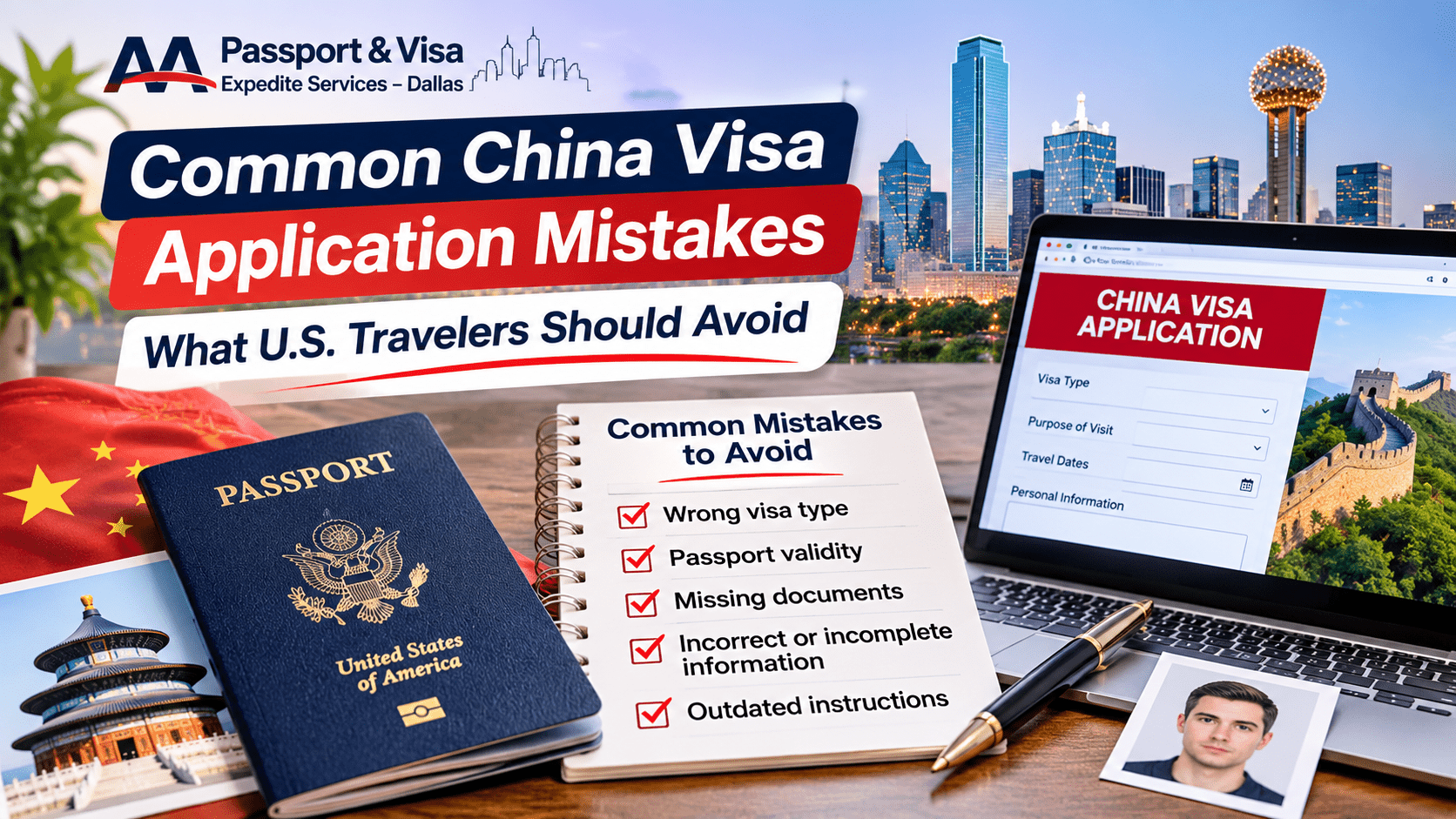
Applying for a Chinese visa can look straightforward at first. You complete an online application, upload the required documents, submit your passport when instructed, pay the appropriate government fee, and wait for processing.
In reality, many China visa applications become more complicated because of small mistakes that could have been avoided before submission.
A passport number entered incorrectly, an outdated document checklist, the wrong visa category, incomplete proof of residence, insufficient passport validity, or missing business documentation can all result in extra questions or delays.
For U.S. travelers, the process has also changed significantly. The Chinese Embassy in the United States now uses the China Online Visa Application system, commonly called COVA. Applicants complete the application online, upload supporting documents for preliminary review, and then submit the passport and required original documents after the system indicates that the passport should be submitted.
For travelers living in Texas, including Dallas, Richardson, Plano, Frisco, Garland, Irving, Arlington, Fort Worth, and surrounding DFW communities, applications fall within the Chinese Embassy in Washington, D.C. consular jurisdiction.
If you are preparing for travel to China, AA Passport & Visa can help you understand the process through its China visa service.
Here are the most common Chinese visa application mistakes U.S. travelers should avoid.
Mistake #1: Following an Outdated China Visa Checklist
One of the easiest mistakes is relying on information that is several years old.
China’s visa process has changed significantly.
The Chinese Embassy launched the newer COVA online application process for its U.S. visa operations in September 2025. Applicants now complete the visa application online, upload documents, wait for preliminary review, and then submit their passport after the application status indicates that passport submission is required.
Older websites may still describe a primarily paper-based process or list requirements that have changed.
For example, current Chinese Embassy procedures have simplified supporting-document requirements for certain tourist L visa applicants compared with older application instructions.
The safest approach is to follow the current Chinese visa requirements and procedures directly from the Embassy. Chinese visa requirements and procedures
Do not assume that an old blog post, forum answer, or downloadable checklist still reflects the current process.
Mistake #2: Choosing the Wrong Chinese Visa Category
A Chinese visa is not a single universal travel authorization.
China has different visa categories for different travel purposes.
Two of the most common categories for U.S. travelers are:
L visa for tourism
M visa for commercial and trade activities
If your main reason for traveling is sightseeing, vacation, or leisure travel, the tourist L visa is generally the relevant category.
If your primary purpose is meeting suppliers, negotiating commercial agreements, visiting factories, attending trade meetings, or participating in other business activities, an M visa is generally more appropriate.
Your application form, supporting documentation, invitation information, and stated travel purpose should be consistent.
Do not choose an L visa simply because you think the supporting documents may be easier.
If you are unsure about the distinction, read our previous guide, China Tourist Visa vs China Business Visa: What’s the Difference?.
Mistake #3: Entering Information That Does Not Match Your Passport
Your China visa application should match the information in your passport carefully.
Check items such as:
Full legal name
Passport number
Date of birth
Place of birth
Nationality
Passport issue date
Passport expiration date
The U.S. Department of State specifically advises travelers that biographical information on a Chinese visa should match the U.S. passport, including punctuation and abbreviations.
Do not enter your passport details from memory.
Put the passport beside you while completing the COVA application and compare each field directly against the bio page.
One incorrect passport digit or inconsistent spelling can create unnecessary problems.
Mistake #4: Using a Passport With Insufficient Validity
Your passport must meet China’s requirements before the visa process can move forward smoothly.
Current official guidance states that travelers should generally have a passport valid for at least six months beyond the relevant travel period and sufficient blank visa pages. The Chinese Embassy’s current application guidance calls for more than six months of validity and at least two blank visa pages.
Before starting your application, check:
Passport expiration date
Number of blank visa pages
Whether the passport is damaged
Whether your personal information is still correct
If your passport does not meet the requirements, resolve the passport problem first.
AA Passport & Visa provides passport renewal assistance for Dallas-area travelers.
If you need a new passport instead of a renewal, review the New Passport Dallas service.
You can also read our previous guide to first-time U.S. passport requirements in Dallas.
Mistake #5: Uploading Blurry or Incomplete Documents
The COVA system relies on uploaded supporting documents during preliminary review.
That makes document quality important.
Potential problems include:
Blurry passport scans
Cropped identification
Missing document pages
Unreadable residence documents
Poor-quality photographs
Incomplete invitation letters
Files that do not show the full document
Before uploading anything, make sure the document is readable at normal size.
The entire page should be visible.
Do not crop off:
Corners
Names
Dates
Addresses
Signatures
Company seals
Passport numbers
A clean digital file may save time during review.
Mistake #6: Ignoring Proof of Residence and Consular Jurisdiction
This is particularly important for applicants in Dallas and throughout Texas.
Texas is currently listed within the Chinese Embassy in Washington, D.C. consular jurisdiction.
Your residence information should therefore be accurate and supported by appropriate documentation when required.
Depending on the case, proof of residence can include documents such as:
Driver’s license
Utility bill
Bank statement or similar residence evidence
If you recently moved, check that the address entered in your application is consistent with the supporting documentation you plan to submit.
Jurisdiction errors can create unnecessary complications.
Mistake #7: Submitting an Incomplete Business Invitation for an M Visa
This is one of the biggest differences between tourist and business visa applications.
If you are applying for a China business M visa, you will normally need supporting documentation connected to the commercial or trade activity.
This can include an invitation from the business or trade partner in China.
Depending on the situation, the invitation may need information such as:
Applicant’s name
Passport details
Purpose of travel
Proposed arrival and departure dates
Planned locations
Commercial activities
Name of the inviting organization
Company address
Contact information
Relationship between the applicant and inviting company
Appropriate signature or company information
Do not submit a vague invitation that simply says someone is invited to China.
The business documentation should support the same commercial purpose stated in the application.
Mistake #8: Assuming Every Tourist Visa Needs Hotel and Flight Reservations
The opposite problem also occurs.
Some travelers prepare extensive hotel reservations, airline itineraries, and invitation documentation because they are following older L visa instructions.
China simplified supporting-document requirements for tourist L visas filed in the United States. Applicants should follow the current requirements rather than automatically relying on older document lists.
However, simplified requirements do not mean that Chinese consular authorities can never request additional documentation.
Applications are still reviewed individually.
If additional information is requested, provide exactly what the Visa Office asks for.
Mistake #9: Applying Too Close to Your Travel Date
Another common China visa application mistake is waiting until travel is extremely close.
The Chinese Embassy currently lists average processing times after passport submission of:
Regular service: approximately 4 business days
Express service: approximately 3 business days in urgent situations
Those timelines are averages and are calculated from passport submission, not necessarily from the day you first start completing the online application. Some cases can require additional processing.
Before passport submission, you may still need time for:
Completing COVA
Uploading documents
Preliminary review
Correcting issues if requested
Receiving passport-submission instructions
Then you also need to consider:
Weekends
Chinese Embassy closures
U.S. holidays
Chinese holidays
Courier time
Return delivery
Do not calculate your deadline using only the four-business-day reference.
Start early.
Mistake #10: Assuming Express Processing Is Guaranteed
Paying for express service does not mean every application will automatically be completed within three business days.
The Embassy describes express processing as approximately three business days for urgent situations, but it also states that some applications may require longer processing.
Consular officers may need additional time for review.
Do not purchase expensive, nonrefundable travel arrangements based only on the assumption that express processing must finish on a specific date.
Mistake #11: Confusing Chinese Government Fees With AA Passport Service Fees
Travelers sometimes see multiple charges and assume they are all government fees.
They are not.
The Chinese Embassy and Consulates-General in the United States have extended the reduced visa fee policy through December 31, 2026.
For a U.S. citizen, the current regular visa fee is $140.
Express service currently adds $25 per visa when applicable.
Current Chinese Government Visa Fees for U.S. Citizens
| Service | Current Government Fee |
|---|---|
| Regular Chinese visa | $140 |
| Express service | +$25 |
| Regular visa + express | $165 |
You can review the official Chinese visa fee schedule from the Embassy. Chinese visa fee schedule
AA Passport & Visa Professional Fees
AA Passport & Visa is a private passport and visa expediting company.
AA professional service fees are separate from:
Chinese government visa fees
Express processing charges
Courier expenses
Shipping charges
Other applicable third-party costs
Keeping those amounts separate makes the total cost much easier to understand.
Mistake #12: Forgetting Previous Chinese Visa Information
Applicants who previously received Chinese visas may need information from those older visas.
Do not throw away an older passport simply because it has expired.
It may contain useful information such as:
Previous China visa number
Previous travel dates
Visa category
Validity information
Previous residence permit information
Current COVA procedures may require details or documentation relating to previous Chinese visas or residence permits.
Keep the previous passport available until your new visa process is complete.
Mistake #13: Forgetting Name-Change or Naturalization Documentation
Certain applicants may need additional identity documentation.
This can occur when:
Your legal name changed
You previously held another nationality
You were formerly a Chinese citizen
Your old passport uses a different name
Former Chinese citizens applying after naturalization may face additional documentary requirements.
Do not assume that your current U.S. passport is always the only identity document relevant to your China visa history.
If your identity or nationality history is more complicated, prepare supporting documentation before submitting the application.
Mistake #14: Not Reviewing COVA Before Submission
The COVA application contains a significant amount of information.
Once you reach the end, it can be tempting to submit immediately.
Do not.
Review the entire application first.
Double-check:
Passport details
Full name
Birth information
Address
Employer details
Travel purpose
Intended dates
Previous China travel
Previous Chinese visa information
Invitation details
Residence information
Uploaded documents
The Chinese Embassy’s visa FAQ currently notes that once an application has been submitted online, it cannot simply be edited. If incorrect or incomplete information is discovered after submission, applicants may need to cancel, correct, and resubmit the application.
A careful review before submission is much easier.
Mistake #15: Not Checking the Visa After Issuance
Receiving your passport back does not mean you should immediately put it in your travel bag.
Check the visa first.
Verify:
Your name
Passport number
Visa category
Number of entries
Validity dates
Duration of each permitted stay
The Embassy instructs applicants to check the information on the issued visa and raise inaccuracies promptly.
Correcting a problem before departure is much easier than discovering it at the airport.
Mistake #16: Confusing Visa Validity With Duration of Stay
Visa validity and permitted duration of stay are different.
Visa validity generally refers to the period during which the visa may be used for entry.
Duration of stay refers to how long you may remain after each permitted entry.
For example, a visa may remain valid for multiple entries over a long period, but that does not necessarily mean you can remain continuously in China throughout that entire period.
Always read the actual visa carefully.
Mistake #17: Assuming U.S. Citizens Can Generally Enter Mainland China Without a Visa
China has expanded visa-free policies for citizens of various countries, which sometimes creates confusion among U.S. travelers.
But U.S. passport holders generally still need an appropriate Chinese visa before entering mainland China unless they qualify for a specific exception.
The U.S. Department of State currently states that U.S. citizens generally must obtain a visa before travel, subject to limited visa-free or transit exceptions.
Before relying on any visa-free arrangement, check current China travel and entry information for U.S. citizens. China travel and entry information for U.S. citizens
Do not rely solely on a social media post or an article discussing visa-free rules for citizens of another country.
A Better Chinese Visa Application Checklist
Before submitting your application, use this checklist.
Passport
More than six months of remaining validity
At least two blank visa pages
Passport information entered correctly
Clear bio-page scan
Visa Category
Confirm that your category matches the primary purpose of travel.
For example:
L visa: tourism
M visa: commercial/trade activity
COVA Application
All required fields completed
Passport details checked
Travel purpose consistent
Supporting uploads readable
Application reviewed before submission
Residence and Jurisdiction
Correct U.S. address entered
Appropriate proof of residence available
Correct Embassy or Consulate jurisdiction selected
Supporting Documents
Depending on your case, prepare:
Business invitation
Previous Chinese visa information
Previous passport
Name-change documentation
Naturalization documents
U.S. immigration-status documentation if applicable
Fees
For U.S. citizens under the current reduced-fee schedule:
Regular government visa fee: $140
Express surcharge when available: $25
AA Passport & Visa professional fees remain separate.
Timing
Allow enough time for:
COVA completion
Preliminary review
Corrections
Passport submission
Processing
Shipping or pickup
Why Dallas Travelers Use Professional China Visa Assistance
You are not required to hire a private visa company to apply for a Chinese visa.
Travelers who are comfortable handling the process themselves can follow the appropriate Chinese government procedures.
However, professional assistance can be useful when you are:
Unsure which visa category applies
Applying for a China business visa
Working with an invitation letter
Traveling soon
Dealing with an older passport
Unsure about jurisdiction
Managing previous Chinese visas
Concerned about document preparation
Trying to avoid preventable mistakes
AA Passport & Visa helps travelers throughout Dallas and the DFW Metroplex understand passport and visa procedures.
Get China Visa Help in Dallas
The Chinese visa process is much easier when your documents are prepared correctly from the beginning.
The most important things are to use current information, choose the correct visa category, verify your passport, prepare supporting documents carefully, review COVA before submitting, and allow enough time before travel.
AA Passport & Visa assists travelers throughout:
Dallas
Richardson
Plano
Frisco
Garland
Irving
Arlington
Fort Worth
Surrounding DFW communities
For assistance, visit the AA Passport & Visa China visa service or call (972) 231-1600.
You can also review AA Passport & Visa locations for additional service-area information.
AA Passport & Visa is a private passport and visa expediting company and is not affiliated with the Chinese government, Chinese Embassy, or U.S. government. Government and consular fees are separate from AA Passport & Visa professional service fees.
Frequently Asked Questions
What is the most common mistake when applying for a Chinese visa?
One of the most common mistakes is following outdated requirements or choosing a visa category that does not match the actual purpose of travel. Applicants should follow current COVA instructions and carefully review every field before submission. Dallas travelers who want help reviewing their application can call AA Passport & Visa at (972) 231-1600.
How much passport validity do I need for a Chinese visa?
Current guidance generally calls for more than six months of remaining passport validity and at least two blank visa pages. If your passport does not meet those requirements, consider resolving the passport issue before beginning the visa application.
Do I need hotel and flight reservations for a China tourist visa?
Current simplified procedures for tourist L visa applicants in the United States generally do not require the older standard package of hotel reservations, round-trip flight bookings, detailed itinerary, and invitation letter. Chinese consular authorities can still request additional documents depending on the individual application.
How long does a Chinese visa application take?
The Chinese Embassy currently lists regular processing at approximately four business days and express processing at approximately three business days in urgent situations, calculated from passport submission. These are average reference times and some applications may take longer.
Where can I get help with a China visa application in Dallas?
AA Passport & Visa assists travelers throughout Dallas and the DFW Metroplex with Chinese visa preparation, including tourist and business visa applications. AA is a private expediting company rather than a government agency. For help reviewing documents, application details, fees, or travel timing, call (972) 231-1600.


One Response